
Categories
New Technology Science Technology

SawStop: Electrical current = Safety

ss_logoOne usually doesn’t think of standard tools in the shop as high on the list of “techy gadgets” but one tool is using a pretty neat technology to help improve safety.

SawStop has table saws on the market that if any part of the user’s body comes in contact with the blade, the saw instantly stops, and the blade retracts into the body of the saw.

How does it work?  There is a small electrical current that runs through the blade.  Inside there is an electical sensor that if it senses a change in the voltage (by a finger, or in the case of their demo, a hot dog), it triggers the brake which stops the blade.  The momentum of the spinning blade stopping in a fraction of a section pulls it down into the body of the saw.   Pretty cool stuff.  Check out the vids below.

Of course, they are not cheap.  I think last I saw about $1800 for the contractor model, and $3800 for the cabinet model to start.

Categories
Astronomy Fun Science

Happy 2009

watchAnd did you know that a “leap second” was added in?  Why?  Well very slowly the Earth’s rotation is slowing, so a second was added to compensate.  You can learn more details here.
Wishing all a safe, happy, peaceful, prosperous New Year!

Categories
Education Fun Science

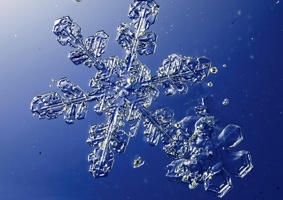
Borax Crystal Snowflakes!

snowflake1

Well it’s Christmas Season again. And I thought I would repost the instructions on how to make Borax Crystal Snowflakes. Our weather has been swinging from 50s to 30s back to 50s again – so no snow here.

So, what do you need?

  • string
  • wide mouth pint jar
  • white, or maybe blue pipe cleaners
  • blue food coloring (optional)
  • boiling water (with adult help)
  • borax (available at grocery stores in the laundry soap section)
  • pencil

Now what you’ll want to do is to shape a snowflake frame from the pipe cleaners, such that one of the pipe cleaners is vertical, and the other two cross in the middle, twisting them together in the middle so that all of the points are equally apart from each other. Next tie the string to one of the points and string along to each pipe cleaner point to make the snowflake shape.

After this tie a length of string from the top point of the snowflake to the pencil, so that the flake will be entirely in the jar, but not touching the bottom.

Now pour the boiling water into the jar and begin adding the Borax into it, stirring in one tablespoon at a time, until you begin to see a little no longer dissolving into the water (now its supersaturated). If you want to use the food coloring, add it in at this point.

Now place the snowflake frame into the solution, using the pencil to hang at the top of the jar and let sit overnight. By the next day, you should have crystals growing on the snowflake!

Categories
Astronomy Physics Science

CERN Large Hadron Collider (LHC)

The CERN LHC (Large Hadron Collider) is set to begin operation tomorrow!  Unfortunately, I have not seen a ton in the mainstream press until today.  The LHC will help scientists to test theories such as what occurred in the fraction of a second after the big bang.  There is a good video on youtube (below) that gives a tour.  Click on the picture above for some great photos of the collider.  Also check out the articles on Boston.com, Sciam.com , and CNN to learn more about the collider.  I also found some much more detailed information on the theories to be tested at Cosmic Variance.

Categories
Astronomy History Science

John Wheeler

wheeler.jpg

John Wheeler – physicist who gave birth to the term ‘black hole’, worked in nuclear fission, and was a contemporary of Albert Einstein and Niels Bohr – has passed away at age 96. Full article here.

Categories
Astronomy Nature Photography Science

Lunar Eclipse!

lunar_eclipse_2008-02-20_1.jpg lunar_eclipse_2008-02-20_2.jpg
In case you missed last night’s lunar eclipse, it was a good one. Luckily the weather mostly cooperated. I took a few pictures, these being the best two – although they are a little fuzzy due to some thin clouds. This being the last one until the end of 2010, I wanted to make sure I got to catch this one. The color on this one was good, the orange/red very visible once it reached totality. (Why is it that color, instead of totally dark? It’s the sun’s light refracting around the earth’s atmosphere as it makes its way to the moon – basically looking at a distance at all the sunrises/sunsets all at once if you were to stand on the moon.)

If you click the pictures above, you’ll see one that is wider angled has two stars visible. The one to the left is actually the planet Saturn. The other bright one above is Regulus, in the constellation Leo.

Pretty cool stuff… although the natives in this story didn’t think so…

Categories
Astronomy Fun Science

Bring Your High SPF Lotion

mars_rock.jpgSome people thought this was evidence of life on Mars, but it’s just a rock. It is cool how the light and shadows does make it resemble a humanlike form. Just think though, if it were a human, how much SPF they would need to protect themselves from the sun rays with Mars’ nice and thin atmosphere -D.