 In thinking of what I should write about as a “Christmastime blog”, I thought of things such as the science behind the Christmas Star (and how much the jury is still out on what exactly it could be, should it be some astronomical event), how Mars is particularly close to Earth today and therefore brighter than usual, so you could tell your young kids that it could be Rudolph leading Santa’s team, or perhaps breaking down how does Santa exactly get to all those kids houses in one night? (This link provides some curious animations of how things would look at near light speed travel.)
But in the end though, I thought it would be cool to do something nice and simple. Something that you could do with your kids over the Christmas break – grow some Borax crystal snowflakes!
So, what do you need?
- string
- wide mouth pint jar
- white, or maybe blue pipe cleaners
- blue food coloring (optional)
- boiling water (with adult help)
- borax (available at grocery stores in the laundry soap section)
- pencil
Now what you’ll want to do is to shape a snowflake frame from the pipe cleaners, such that one of the pipe cleaners is vertical, and the other two cross in the middle, twisting them together in the middle so that all of the points are equally apart from each other. Next tie the string to one of the points and string along to each pipe cleaner point to make the snowflake shape.
After this tie a length of string from the top point of the snowflake to the pencil, so that the flake will be entirely in the jar, but not touching the bottom.
Now pour the boiling water into the jar and begin adding the Borax into it, stirring in one tablespoon at a time, until you begin to see a little no longer dissolving into the water (now its supersaturated). If you want to use the food coloring, add it in at this point.
Now place the snowflake frame into the solution, using the pencil to hang at the top of the jar and let sit overnight. By the next day, you should have crystals growing on the snowflake!
And if you wanted to get the more scientific details about Borax, you can go here.
Wishing everyone a Happy, Healthy, and Safe Christmas and Holiday Season!


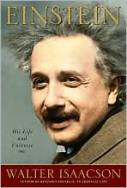 When one thinks of Einstein, the thought probably conjures up the notion of the scientific legend. Or, it perhaps also brings to mind how his name has become synonymous with genius. But the root of this sort of folk lore was an actual man. Einstein: His Life and Universe by Walter Isaacson reveals this man to us. It reveals not only the science (which is well written, readable, and blends into the commentary, not interrupting it), and how he worked to bring about his theories, but also his personal life: his family and working relationships; as well as his social, political, and religious views. It also shows how the times in which he lived shaped him.
 One of the most prevalent forms of science that touches us directly in our daily lives is that of medical science. With all the great strides that have been made in this field, the human factor cannot be diminished – nor should it!
  My good friend over at the
 In case you had started spring cleaning and came across some old 3-D glasses, hold on to them for now. NASA just published pictures of the sun. While the sun is no stranger to the photo shoot, this is
  The Science Attic